
Best Genres for AI Music Generators: What Works Best (and How to Prompt It)
Not every style translates equally when you turn words into a track — a good AI music generator from text shines on pattern-driven genres and stumbles on ones built around live human feel. According to Suno’s own prompting glossary, specificity in genre tags is the single biggest lever over output quality.

The best genres for AI music generators are electronic/EDM, lo-fi hip-hop, ambient, pop, and cinematic/orchestral — because they rely on repeatable loops, clear structure, and texture over live improvisation. Below: which genres win, why, and exactly how to describe mood, tempo, and instruments so your prompt lands.
Which Genres AI Music Generators Do Best — and Why
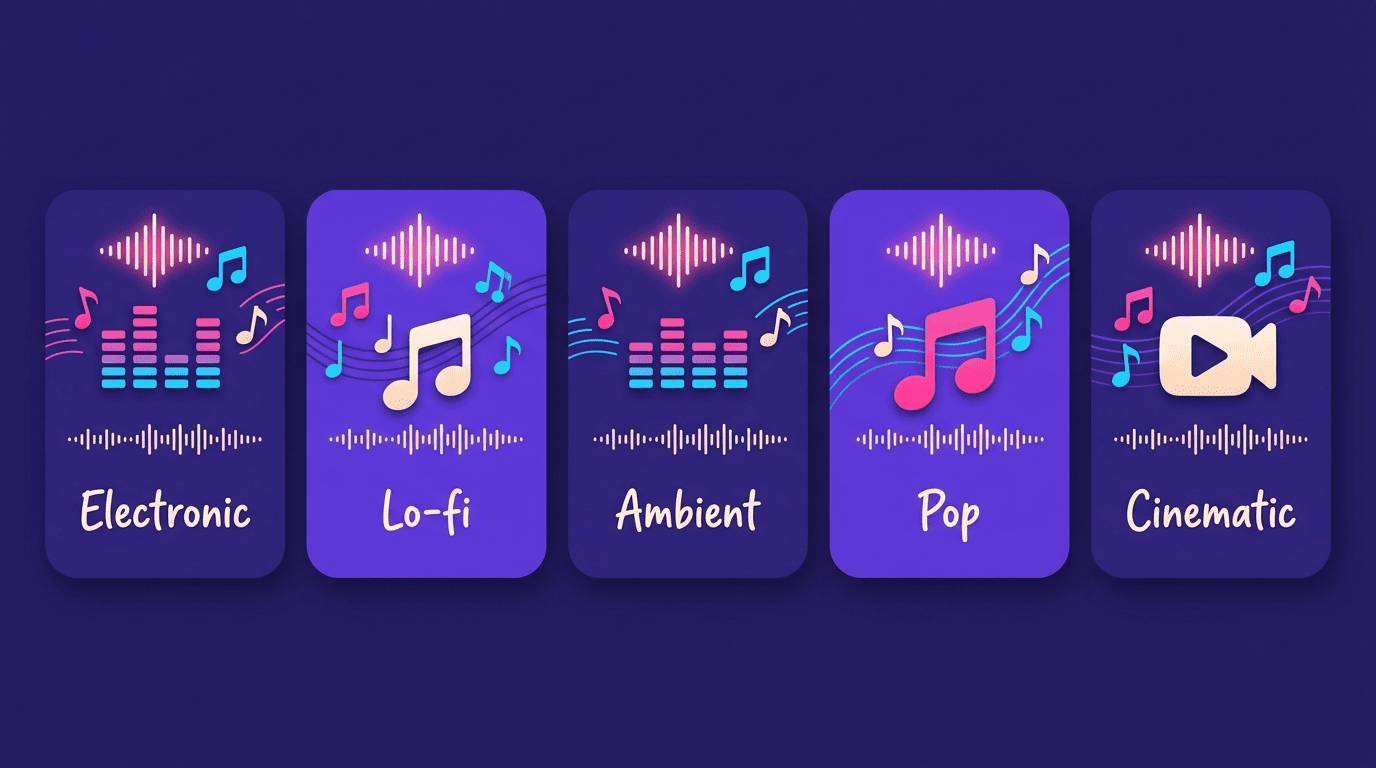
Electronic/EDM, ambient, lo-fi hip-hop, pop, and cinematic/orchestral stabilize at the top of nearly every generative-AI genre roundup. The common thread isn’t luck — it’s structure. These styles are built from synthetic or codified building blocks that a model can learn from repeatable patterns, rather than from split-second human improvisation.
The five genres AI nails
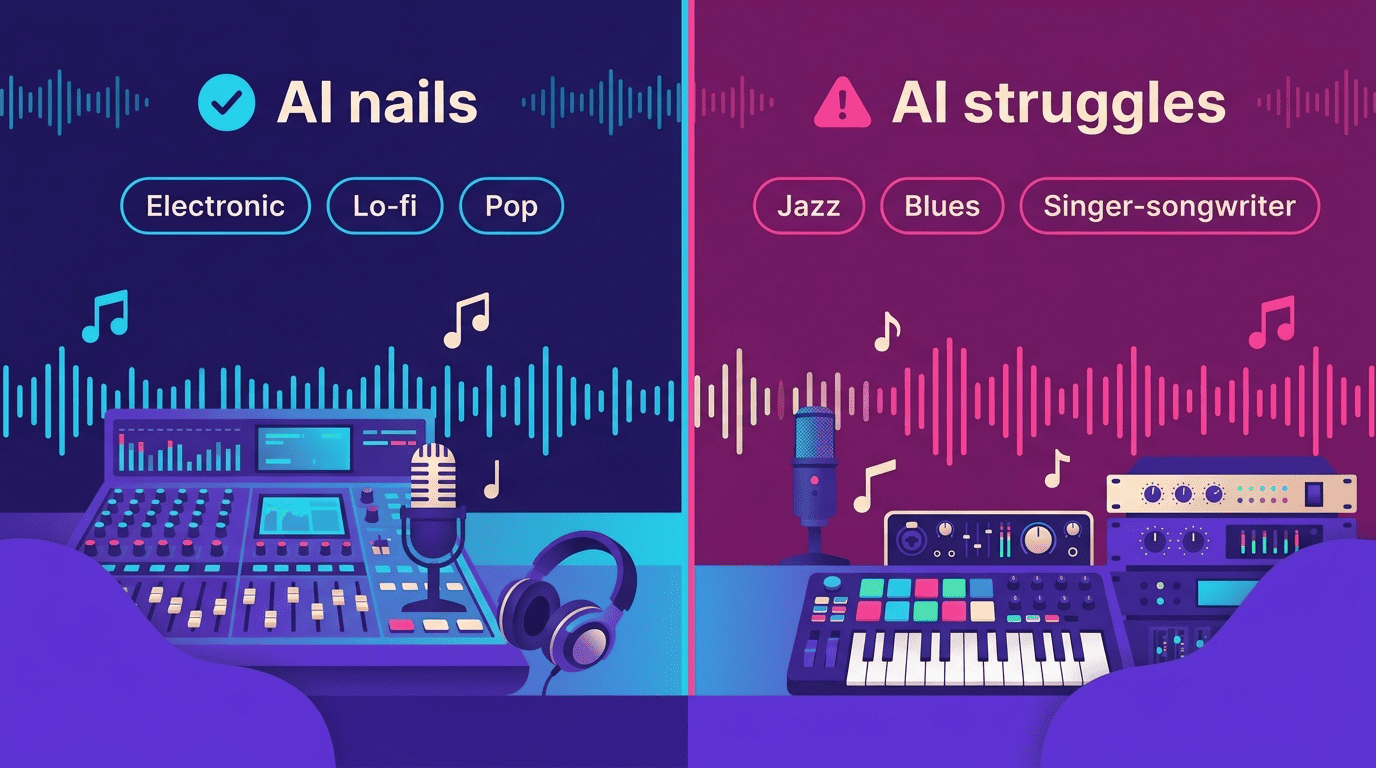
Electronic/EDM, ambient, lo-fi hip-hop, pop, and cinematic/orchestral consistently rank at or near the top across multiple review sites comparing generative-AI music. The reason is straightforward: their sound is either synthetic by nature or built on loop-based repetition, so a model trained on thousands of pattern examples reproduces them convincingly. Synthwave tracks generated from a short text prompt are often indistinguishable from human-made ones — the genre is essentially a set of production conventions (gated-reverb drums, arpeggiated basslines, analog leads) rather than a performance skill.
Why pattern-driven styles win
Pop is the most structurally codified genre in modern music — verse, pre-chorus, chorus, bridge — which is exactly the kind of predictable form a text-to-music AI holds onto reliably. Lo-fi and ambient go a step further: they prioritize texture and atmosphere over technical virtuosity, so vinyl crackle, warm detuned chords, and mellow melodic loops are easy to render convincingly. As MasterClass explains in its guide to lo-fi, the genre’s identity is built on intentional imperfection and repetition rather than instrumental complexity — which happens to be a description of exactly what generative models are good at. EDM and house, meanwhile, lean on a four-on-the-floor kick pattern and 808-driven low end, both of which are simple, learnable rhythmic templates.
The more specific your musical vocabulary, the more control you have over your Suno creations!
Suno Music Glossary
Where AI Music Still Struggles
Not every genre translates cleanly from a text prompt into a convincing track, and it’s worth being upfront about where the technology still falls short rather than overselling it.
Genres to approach with caution
Jazz improvisation is the clearest weak spot: real jazz depends on musicians reacting to each other in real time, trading phrases and bending timing in ways that resist the pattern-completion approach most generators rely on. Authentic blues has a similar problem — it needs emotional rawness and deliberate imperfection, qualities that are hard to fake convincingly from a text description. Vocal-heavy singer-songwriter material can still sound hollow, since a generator can approximate melody and chord progression but struggles to replicate the intimacy of a single human voice carrying a song. If you need one of these genres anyway, lean on mood and instrumentation cues rather than expecting a model to “improvise” — describe the texture you want, not the performance.
Mood, Tempo, and Instruments: the Three Dials That Shape Your Result
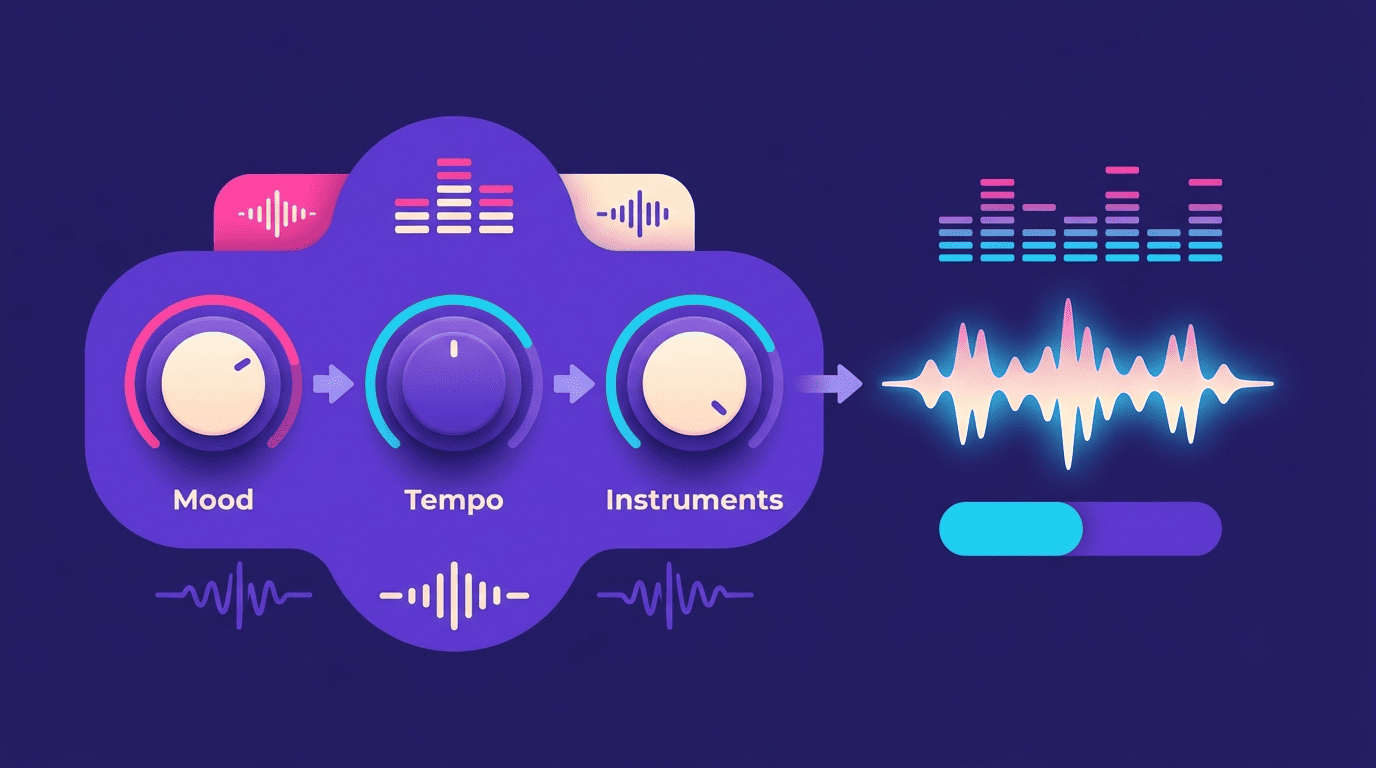
A genre tag alone rarely produces the result you’re picturing. Three additional controls — mood, tempo, and instrumentation — do most of the heavy lifting once the genre is set, and understanding each one separately makes prompt-writing far more predictable.
How mood changes the output
Mood words set the emotional register of a track: “nostalgic and bittersweet,” “uplifting,” “dark and cinematic,” “ethereal and meditative.” Evaluative, feeling-based language tends to work better than music-theory jargon — a generator responds more reliably to “nostalgic” than it does to “C minor.” For a short prompt, mood often matters more than nailing an exact BPM number, since it steers the overall arrangement, not just the rhythm.
How tempo/BPM sets the energy
Tempo is the fastest way to shift a track’s energy without changing genre. A slow tempo (60-90 BPM) reads as calm, intimate, and focused; a mid tempo (90-120 BPM) sits in groove territory; a fast tempo (120-160+ BPM) pushes toward dance-floor drive. Lo-fi hip-hop typically lives around 70-90 BPM, while EDM and house sit closer to 120-128 BPM. You can specify tempo as a number (“90 BPM”) or as a descriptor (“slow-burning,” “driving,” “sparse”) — both work, and combining them works even better. For reference, the classical Italian tempo markings run from Grave (roughly 20-40 BPM) up through Prestissimo (200+ BPM), which is a useful anchor if you’re translating a mood into a number.
How instruments define the genre
Naming specific instruments is the fastest way to lock in a genre. “Fingerpicked nylon guitar” produces a far more targeted result than “acoustic guitar,” and “warm upright bass” beats a bare “bass” every time. Genre-defining instrument combinations are worth memorizing: lo-fi leans on jazzy piano, dusty drum loops, and vinyl crackle; EDM favors analog pads, arpeggiated bass, gated-reverb drums, and 808s; cinematic material calls for strings, choir, and brass; trap needs punchy 808s and skittering hi-hats. Swap in the right instrument words and even a generic genre tag starts to sound purpose-built.
The Genre + Mood + Tempo Matrix
Once you know which dials to turn, it helps to see them laid out side by side. The table below is a quick reference for pairing a genre with its typical mood, BPM range, and signature instruments — treat the numbers as a starting point, not a hard rule.
Quick-reference table
| Genre | Typical mood | BPM range | Signature instruments/texture |
|---|---|---|---|
| Lo-fi Hip-Hop | Mellow, nostalgic | 70-90 | Jazzy piano, vinyl crackle, dusty drums |
| EDM / House | Energetic, euphoric | 120-128 | Four-on-the-floor kick, 808s, synth pads |
| Ambient | Calm, ethereal | 40-90 or free | Analog pads, drones, deep reverb |
| Pop | Upbeat, catchy | 100-125 | Vocals, piano, synths, verse-chorus form |
| Cinematic / Orchestral | Epic, emotional | 60-110 | Strings, brass, choir |
| Trap | Dark, hype | 130-150 (half-time) | 808s, skittering hi-hats |
| Synthwave | Nostalgic, neon | 80-118 | Gated-reverb drums, arpeggiated bass |
| Afrobeats | Warm, danceable | 100-118 | Log drum, layered percussion |
How to Describe Each Genre in a Prompt (Examples)
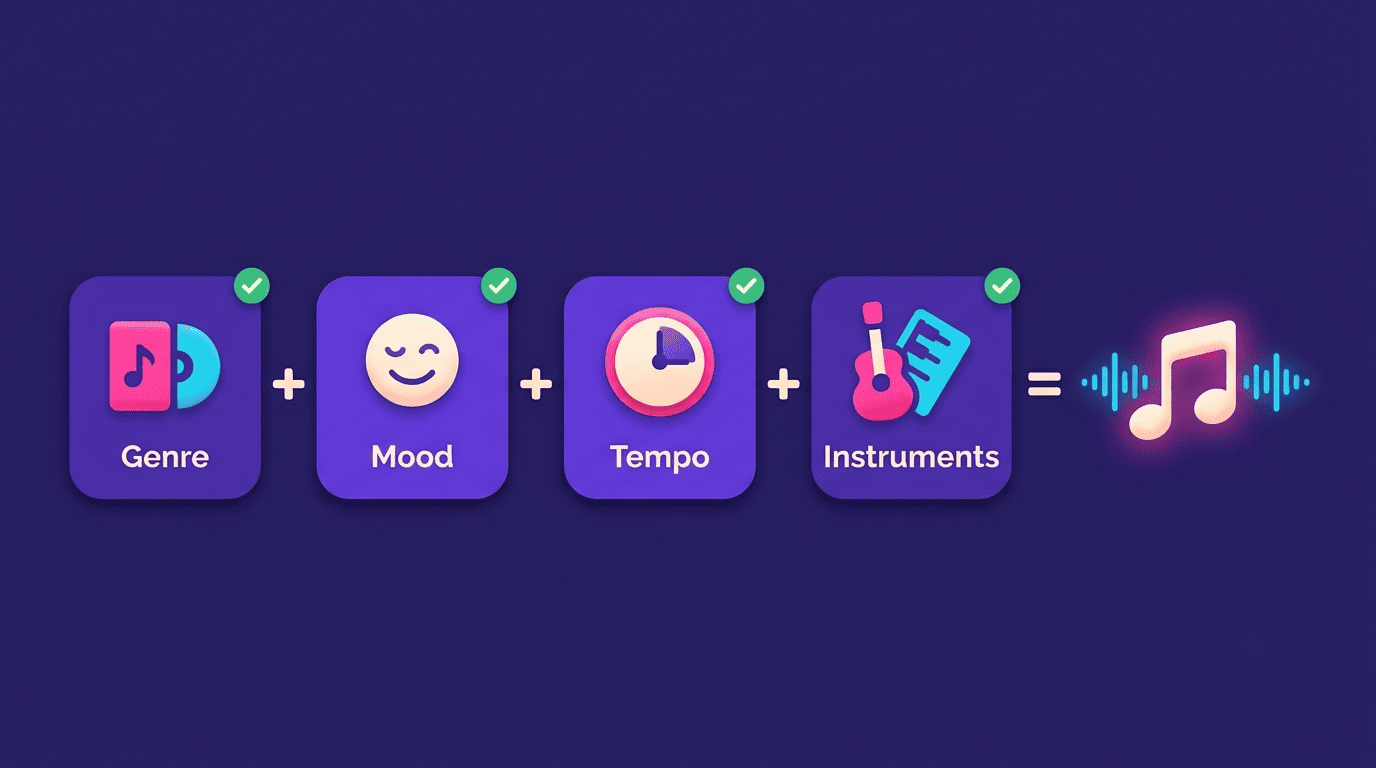
Once you understand the genre-mood-tempo-instrument formula, writing a prompt becomes closer to filling in a template than starting from a blank page.
Prompt recipes by genre
A working prompt formula is genre + mood + tempo + instruments, with an optional line about the story or setting. Somewhere between 5 and 8 tags tends to hit the sweet spot — fewer than 4 and you get a generic, average result; more than 10 and the model starts ignoring the tail end of the list. Order matters too: lead with the genre, follow with mood, then instruments.
- Lo-fi: “Lo-fi hip-hop, mellow and nostalgic, 80 BPM, jazzy Rhodes piano, dusty drum loop, vinyl crackle.”
- EDM/House: “Progressive house, euphoric and uplifting, 126 BPM, four-on-the-floor kick, analog synth pads, arpeggiated bass.”
- Ambient: “Ambient, calm and ethereal, slow, warm analog pads, evolving drones, deep reverb, no drums.”
- Cinematic: “Cinematic orchestral, epic and emotional, 90 BPM, soaring strings, brass swells, choir.”
- Trap: “Trap, dark and hype, 140 BPM half-time, booming 808s, skittering hi-hats, sparse piano.”
- Synthwave: “Retro synthwave, neon and driving, 110 BPM, gated-reverb drums, arpeggiated bassline, analog lead.”
Each of these follows the same order — genre first, mood second, instruments third — which is worth copying even when you swap in your own genre. It’s a small habit that consistently steers AI music from text closer to what you actually hear in your head, whether you’re working in electronic dance music or something quieter.
Blending genres for a unique sound
Blending genres widens the palette well beyond any single style: lo-fi + jazz + ambient, trap + cinematic, jazz + trap, classical EDM, and rock lo-fi are all workable combinations once you know each genre’s own mood and tempo range. Stick to 2-3 genres at most — stack more than that and the result tends to blur into a formless mix rather than a distinct hybrid sound. If you plan to remix or fine-tune the result afterward, export stems or WAV files rather than settling for the compressed preview.
A few habits carry over regardless of genre:
- Start with a genre tag, not a mood tag — genre sets the production template.
- Layer in one mood descriptor that captures the emotional target.
- Add a tempo, either as a number or a feel-based word.
- Name two or three instruments that define the genre’s texture.
- Keep the whole prompt to 5-8 tags total.
- Test a blend of two genres only after each one works well on its own.
- Export stems if you intend to edit the track further.
This kind of text-to-music AI workflow rewards small, repeatable habits more than one perfect prompt — incremental testing beats trying to nail everything in a single attempt.
FAQ
Once you’ve got a genre and a formula down, the fastest way to test it is to try it — an AI music from text tool lets you swap genre, mood, tempo, and instrument tags in seconds and hear the difference immediately, which is a faster feedback loop than reading about it.