
Commercial Use of AI Music: Can You Legally Monetize AI-Generated Tracks in 2026?
Yes — in most cases you can use AI music commercially, but whether you’re allowed to comes down to one thing: the plan you generated it on. When you make a track with an AI music generator from text, commercial rights come from the tool’s license, not from copyright law by itself.
Free tiers are usually personal-use only, while paid tiers unlock commercial rights — and “owning the copyright” to a track is a separate question governed by U.S. Copyright Office guidance, not by “being allowed to use it commercially.”
This article is general information, not legal advice. AI music rules differ by tool and change fast — always read the specific tool’s current terms, and consult a qualified attorney for high-stakes commercial use.
Can You Use AI Music Commercially? The Short Answer
Commercial use of AI-generated music is possible if you hold commercial rights from your AI generator and comply with the platform where you publish. It comes down to a two-part test: first, does your plan actually grant commercial rights, and second, does the track avoid infringing on existing copyrighted work, samples, or someone’s voice. Skip either part and you risk a DMCA takedown, removal, demonetization, or an account ban — even if the music itself sounds completely original.
Commercial use is a broad category. It typically includes:
- Advertising and marketing campaigns
- YouTube and social media monetization
- Client and agency delivery work
- Background music for retail spaces, apps, and games
- Product launches and promotional content
- Selling or licensing tracks outright
It’s worth contrasting that list with personal use — private listening, or a non-monetized hobby video — which is what most free-tier AI-generated music is limited to. The gap between the two is exactly where creators get into trouble: a track made for a weekend project can end up in a client’s ad campaign without anyone checking whether the license allows it.
It Depends on the Tool’s Plan: Free vs Paid
Every AI music generator treats commercial rights differently, and the split almost always runs along the free-versus-paid line. Before assuming a track is safe to publish, check exactly which tier produced it.
| Tool / Model | Free tier | Paid tier | Commercial rights |
|---|---|---|---|
| Suno | Personal use only | Pro / Premier | Commercial rights on Pro and Premier plans |
| Udio | Personal use only | Standard / Pro | Commercial use specifically on the Pro tier |
| Envato MusicGen | — | Every output (Envato Elements subscription) | Perpetual commercial license bundled in, covering distribution and modification — but not standalone resale or streaming release |
Free tiers are usually personal-use only
Suno’s own help center confirms that commercial rights are granted only on its Pro and Premier plans; free-tier generations are for personal use only. The same help article spells out a gotcha worth flagging directly: upgrading to a paid plan “does not give you retroactive commercial use licensing” for songs you already made while on the free plan by default.
Suno’s terms can change, so check the current help center article before relying on this for anything you’ve already published. If a track matters commercially, treat the date you generated it, and the plan you were on that day, as part of its provenance record.
Paid tiers unlock commercial rights — read the specifics
Udio’s tiers are Free, Standard, and Pro; per reporting from ONCE and Music Make AI, commercial rights are specifically tied to the Pro tier, not automatically granted on every paid plan — Standard-tier commercial status is less clearly documented, so confirm your exact tier before publishing. Udio’s licensing has also been in flux following its 2026 licensing deal with major labels, which reportedly affected track downloads for some users — another reason to check the current terms rather than an older summary.
Some tools skip the tiered-plan model entirely: Envato MusicGen, for instance, bundles a perpetual commercial license into every output as part of an Envato Elements subscription, covering distribution and modification within a larger end product — but per Envato’s licensing terms, that license does not cover selling or distributing the AI-generated track as a standalone piece of music or releasing it on streaming services.
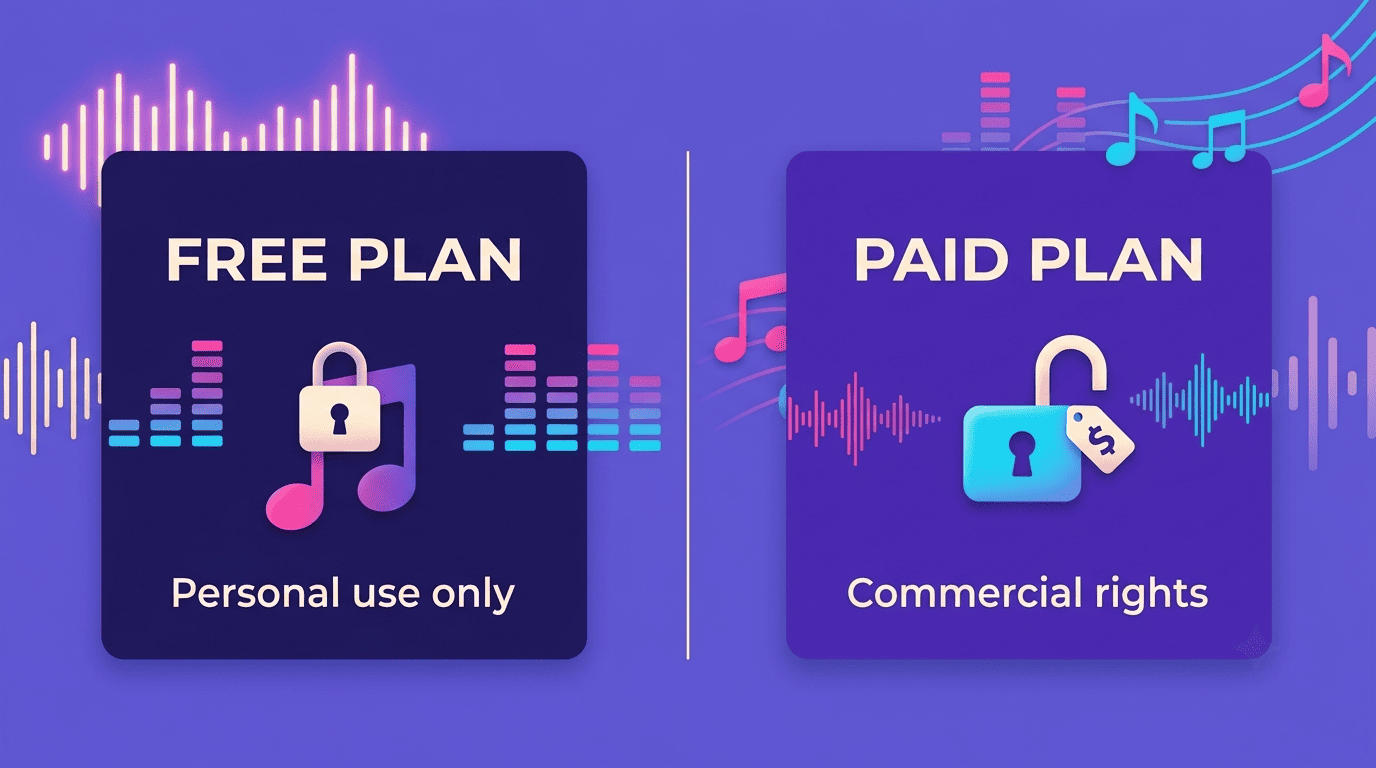
But “commercial rights” is not one fixed bundle — each tool defines the scope differently, and resale, broadcast rights, or sublicensing to a client may be excluded even on a paid plan. Read the current terms rather than assuming parity between tools just because both charge a subscription.
Always check the current Terms of Service
AI music policy moves quickly — new label disputes and platform updates can change what’s allowed within a single quarter. That’s exactly why it’s worth locating the license or terms page for your specific tool at the moment you generate a track, rather than relying on a summary written months earlier.
Keep a copy or receipt of that generation for future reference — a screenshot of the terms page alongside your export, dated the day you made the track, is enough to establish what you were promised at the time.
Copyright vs Commercial License: Do You Actually Own It?
Having commercial rights to use a track is not the same as owning copyright in it, and conflating the two is where a lot of confusion about AI-generated music starts.
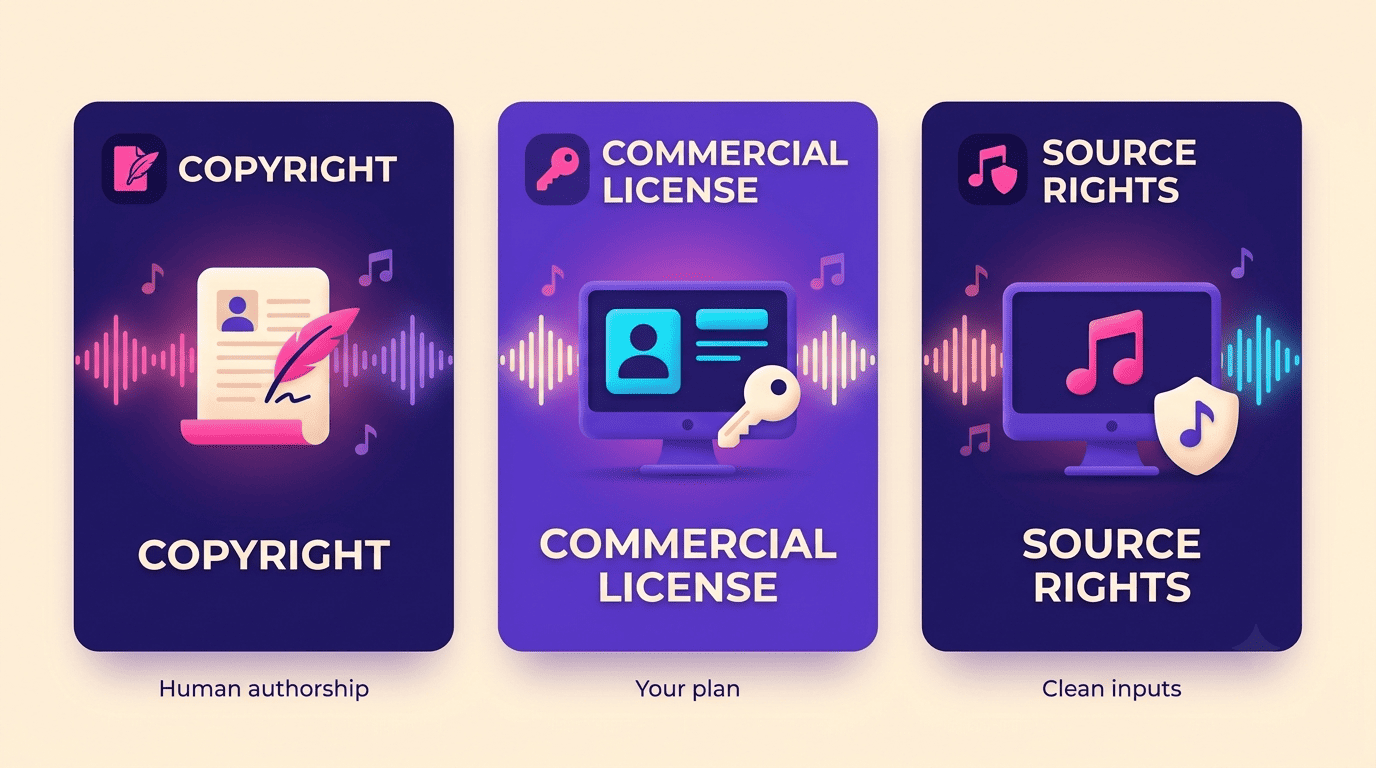
Three separate layers: copyright, license, source rights
It helps to separate three distinct questions, a framing echoed in reporting from Music Make AI:
- Copyright — do you have human authorship strong enough to stop others from copying your track?
- Commercial license — does your plan let you use the output in a business context at all?
- Source rights — did the inputs (training data, samples, prompts referencing existing songs) infringe on someone else’s work?
A track can pass one test and fail another, so treating these as a single bundled “right” is a mistake.
Why fully AI-made tracks may have no copyright
U.S. Copyright Office guidance from 2025–2026 holds that works generated purely by AI without meaningful human authorship generally can’t be registered for copyright protection, as detailed on the U.S. Copyright Office’s site. The practical consequence is counterintuitive: you may still be allowed to sell or use a fully AI-generated track through your commercial license, but you may not be able to stop someone else from copying it, since there’s no registrable copyright behind it.
This matters most for creators who plan to build a brand around a specific track — a jingle, a theme, a signature sound. Without a registrable copyright, your recourse against a copycat runs through the platform’s terms and trademark law, not through copyright infringement claims.
How human input changes the picture
Meaningful human contribution — arrangement, editing, original lyrics, or substantial creative direction over the generation — may earn a track partial copyright protection, decided case-by-case according to Music Make AI and BrewerLong. The U.S. Copyright Office’s January 2025 Part 2 report on copyrightability grounds that standard in a federal court’s own words:
Copyright law protects only works of human creation, and human authorship is a bedrock requirement of copyright.
U.S. District Court for the District of Columbia, as cited in the U.S. Copyright Office’s Part 2 report
That standard is exactly why “how much did a human actually shape this” ends up being the deciding factor in copyright, separate from whatever your commercial license already grants you.
Monetizing on YouTube and Content ID
Commercial rights from your generator are only half the equation on YouTube — the platform’s own Content ID system and monetization policy sit on top of whatever your license allows.
What Content ID does and why AI music can get flagged
YouTube’s Content ID system, described in YouTube’s own Help documentation, scans uploads against a database of reference files supplied by rights holders. AI music can trigger a claim in two different ways: a false positive, where the algorithm hears an echo of a protected recording that isn’t actually a copy, or a legitimate claim, where the AI output genuinely reproduces a melody, sample, or vocal pattern close enough to something already registered.
Either way, the claim lands on your video before you get a chance to explain the source, and disputing a Content ID claim takes time — which is why it pays to check a track before it’s already live on a monetized channel, not after.
YouTube’s stance on AI music
YouTube moved in 2025 toward limiting AI-generated music that lacks clear human input, according to reporting from Silverman Sound and Music Make AI. That direction is attributed to those sources rather than confirmed against YouTube’s policy text directly here.
Check YouTube’s current music and monetization policy before assuming an older workflow still applies, since platform rules on AI content have been revised multiple times and a channel built entirely on unmodified, fully AI-generated tracks is the profile most likely to lose monetization eligibility.
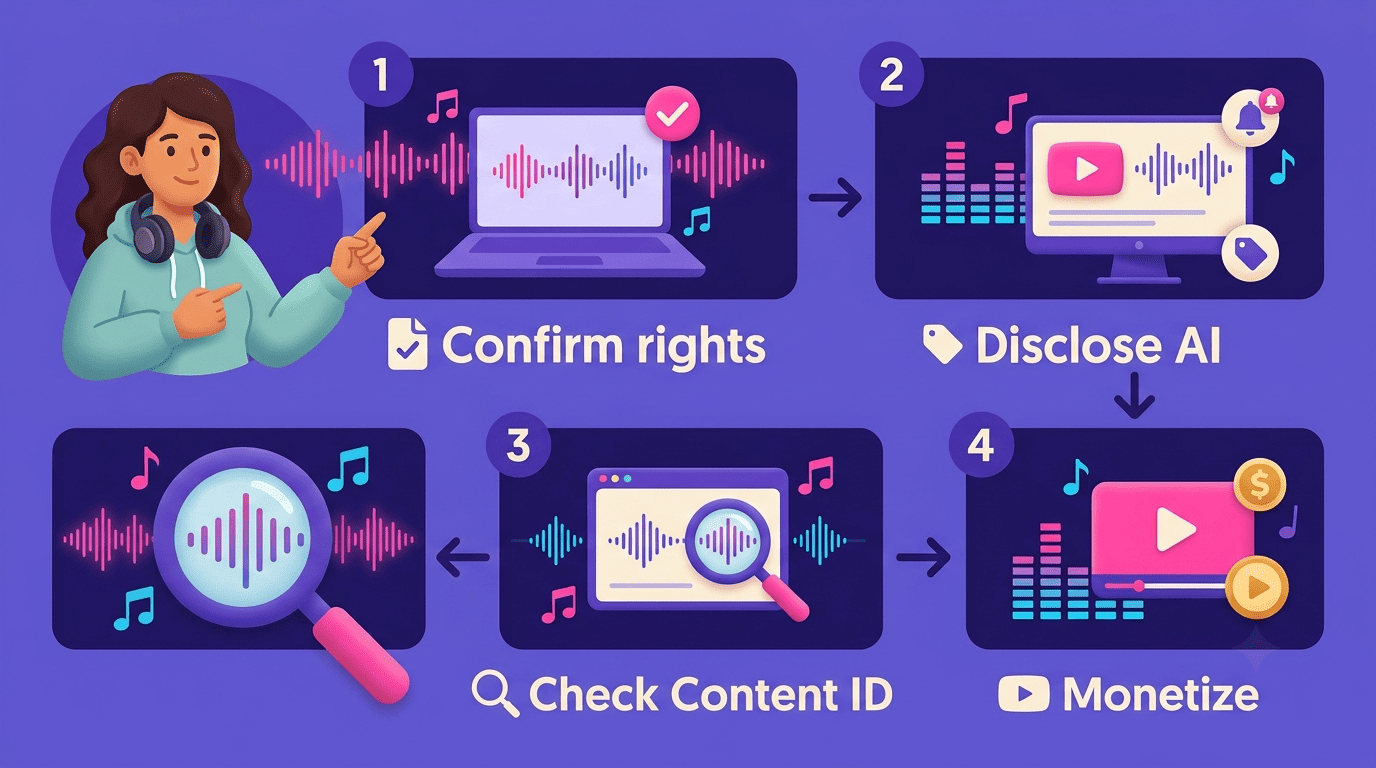
Practical steps to monetize safely
Before turning on monetization for a video built around AI-generated music:
- Confirm your generator’s plan actually grants commercial rights.
- Add AI-disclosure labeling where YouTube or your distributor requires it.
- Avoid mimicking a specific real artist’s voice or style closely enough to invite a claim.
- Keep your generation receipts and prompt history as provenance.
- Check Content ID status on the track before publishing, not after.
Skip these steps and the downside isn’t hypothetical — demonetization, takedown notices, and channel strikes are the direct consequences of publishing unlicensed or unclear AI music at scale.
Using AI Music in Ads, Client Work, and Selling Tracks
Client and agency work raises the stakes because the AI-created music leaves your hands into someone else’s use case entirely — which is where the AI music from text workflow matters just as much for the license attached to the output as for the sound itself.
Ads and client/agency projects. Using AI-generated music in an ad or a client deliverable is allowed if your license permits commercial use and, specifically, delivery to a third party — check whether “client work” or sublicensing to a client falls inside the scope of your plan, since some licenses restrict transfer even when they allow commercial use in-house. When you do hand a track to a client, deliver a copy of the license terms alongside it, so there’s a record of what rights actually transferred.
Selling AI tracks and royalty-free resale. No U.S. law specifically bans selling AI-generated music if you hold the rights to do so, per BrewerLong’s legal analysis. That source lays out four conditions worth treating as a checklist: rights to the tool’s output, no false claim of the track as an “original copyrighted work,” no infringement of existing songs, samples, or someone’s likeness, and no misrepresented authorship. Stock-audio resale and exclusive-rights sales carry the highest risk of the group, according to Music Make AI, because they promise buyers a level of exclusivity or originality the underlying license may not actually support.
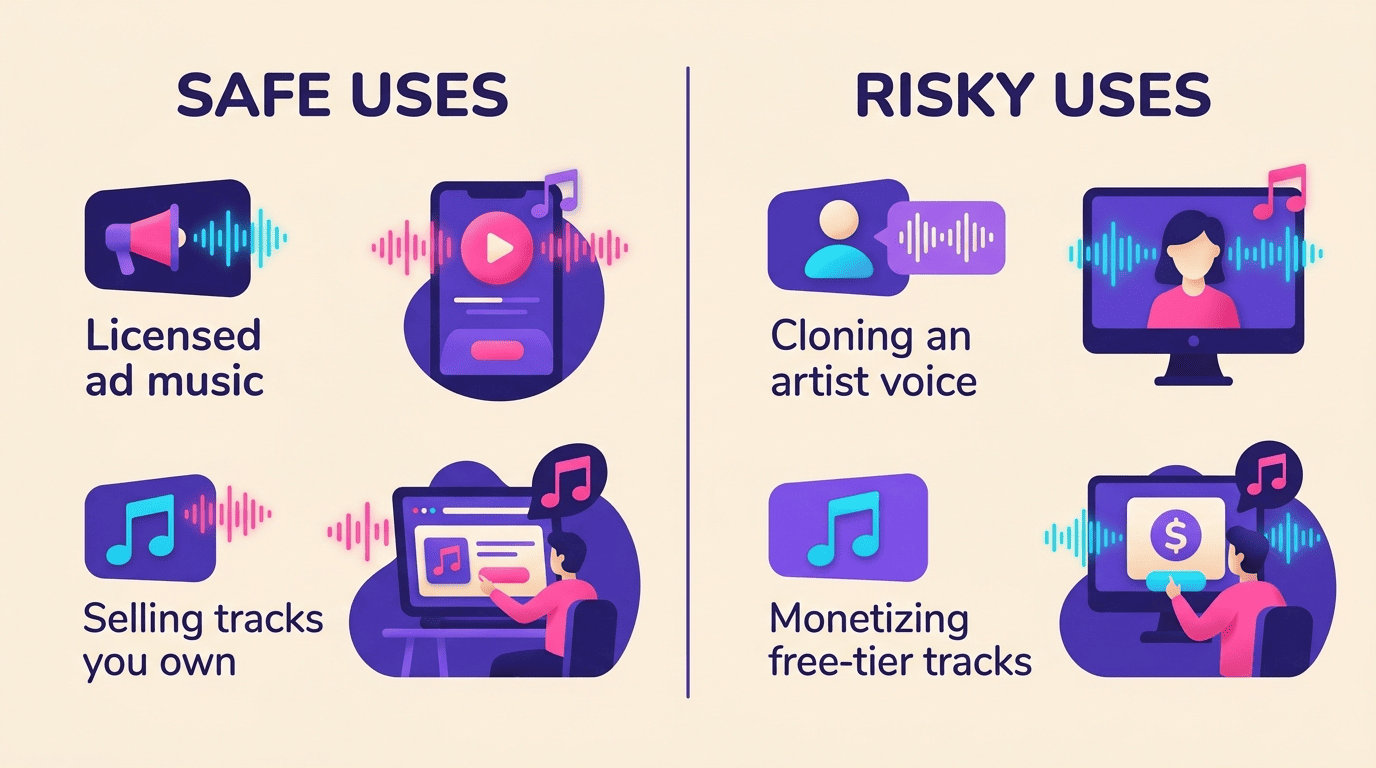
Watch the likeness / right-of-publicity trap. Cloning a named artist’s voice, or invoking their name or image in marketing a track, can violate their right of publicity even when the underlying composition is technically original — a risk flagged by both BrewerLong and Silverman Sound. The viral “Heart on My Sleeve” episode, where an AI track cloned a well-known artist’s voice without authorization, is frequently cited as a cautionary example of exactly this trap; treat it as reported context rather than a specific legal ruling.
| Use case | Status |
|---|---|
| Client ad with a paid-tier commercial license | OK, if sublicensing to clients is in scope |
| Selling original AI tracks you hold rights to | OK, if authorship isn’t misrepresented |
| Cloning a named artist’s voice for a release | Risky — right-of-publicity exposure |
| Monetizing free-tier output on YouTube | Risky — free tiers are typically personal-use only |
| Exclusive-rights resale without verifying license scope | Risky — highest-risk category per Music Make AI |
Risks and a Pre-Use Best-Practices Checklist
Even with the right license in hand, AI-generated music sits in a legal environment that’s still moving — which is exactly why a short pre-use checklist is worth running every time, not just once.
The real-world risks
Takedowns, demonetization, account bans, and an evolving wave of litigation between record labels and AI music developers all add up to moving-target risk, according to reporting referencing RIAA-related disputes. That’s not a verdict on any single tool’s legality — it’s a reason for caution, because the legal ground under any text-to-music AI output is still shifting as courts and platforms work through these cases.
None of this means AI-generated music is unusable commercially — it means the burden of checking terms and provenance sits with the person publishing the track, not with the tool that generated it.
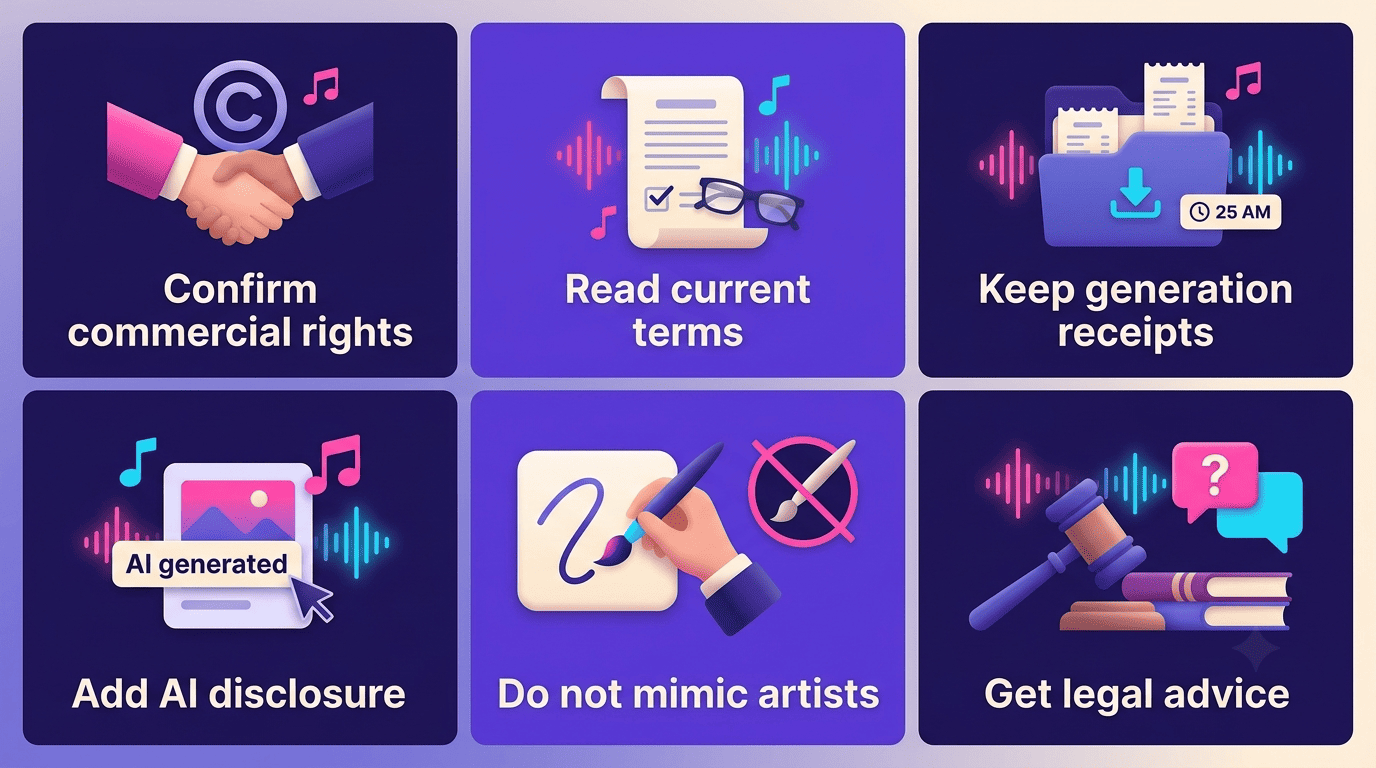
A practical pre-use checklist
- Confirm your plan grants commercial rights before you publish anything.
- Read the tool’s current terms — don’t rely on last year’s summary.
- Keep generation receipts and prompt history as provenance.
- Add AI disclosure metadata wherever your distributor or DSP requires it.
- Don’t mimic a specific real artist’s voice, name, or likeness.
- Register with a PRO — ASCAP, BMI, or SESAC — if you expect performance royalties.
- For high-stakes commercial use, get a qualified attorney to review the specifics.
Two more entities worth tracking separately from the checklist above: distributors and DSPs are increasingly requiring AI disclosure metadata on uploads, and publishing royalties — mechanical and performance income — flow through a PRO like ASCAP, BMI, or SESAC rather than through the distributor itself, so registering a track commercially doesn’t automatically register it for royalty collection.
This is general information, not legal advice — verify the specific tool’s current terms, and consult a professional before committing to high-stakes commercial use of AI-generated music.