
Who Owns AI-Generated Music? Copyright, Authorship & Your Rights Explained
When you type a prompt into an AI music generator from text and a finished song appears seconds later, a practical question follows right away — who actually owns it? Under current US law, a track that is purely machine-made typically belongs to no one as a matter of copyright, according to the US Copyright Office, while the right to use that track comes from the platform’s license, not from copyright ownership.
This guide separates three things people constantly confuse — copyright, authorship, and a platform license — and walks through what the Copyright Office has actually published on AI-generated music. This is general information, not legal advice; for a specific release or commercial project, consult a qualified attorney before you publish or monetize AI-assisted work.
Copyright vs. License vs. Ownership: Three Different Things
Most confusion around AI-generated music starts with a single word — “ownership” — being used for two very different legal ideas.
“Owning” a song can mean two very different things
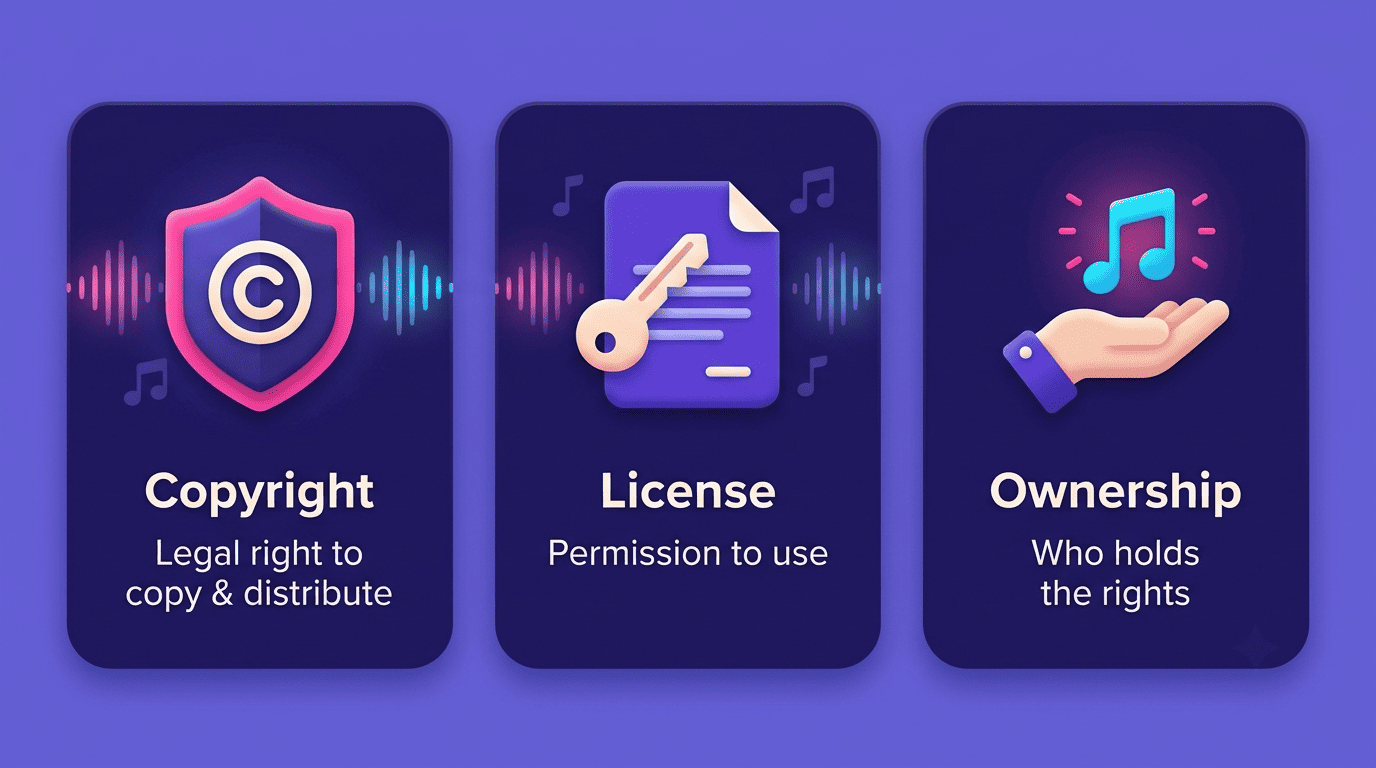
“Ownership” can mean holding a copyright: the exclusive legal right to copy, distribute, and perform a work, enforceable against anyone else who uses it without permission. Or it can simply mean holding a license the tool grants you to use the output for a certain purpose. When a platform’s marketing says “you own your output,” that usually means the platform itself is not claiming the recording — and is licensing commercial use to you — not that a valid federal copyright automatically exists on that piece of AI music.
Why AI output is not automatically public domain
A common assumption is that if a purely AI-generated track cannot be registered for copyright, it must be free for anyone to use. That is wrong. Non-copyrightable output is not automatically public domain — the platform’s terms of service still govern how you may use, distribute, and monetize it. In practice, your real position depends on five factors:
- The platform license you agreed to
- The copyrightability of the track (how much human input went in)
- The status of any source material you uploaded
- The policy of the distribution platform you release on
- The records you kept during creation
| Factor | What it decides |
|---|---|
| Platform license (Suno, Udio, etc.) | Whether you’re allowed to use the track commercially at all |
| Copyrightability | Whether a human-authored element exists that can be registered |
| Source-material status | Whether any uploaded audio/lyrics were legally cleared |
| Distribution-platform policy | Whether streaming services require AI disclosure or block the upload |
| Creation records | Whether you can prove your human contribution later |
Can AI-Generated Music Be Copyrighted at All?
US copyright law protects only material that is the product of human creativity, and this single rule decides almost everything discussed in this guide.
The human-authorship rule
The Copyright Office has been consistent that a work must be created by a human being to qualify for protection. Purely AI-generated output — audio produced with no meaningful human creative input — cannot be registered. This was tested directly in Thaler v. Perlmutter: a federal district court ruled in August 2023 that AI cannot be listed as an author of a copyrighted work, and the U.S. Court of Appeals for the D.C. Circuit affirmed that ruling in March 2025.
What this means for a one-click prompt
If you type a short, generic prompt into a text-to-music AI tool and accept the very first result without changes, there is likely no copyright to own at all — no human made the expressive choices that copyright law protects. This mirrors an older precedent, Naruto v. Slater (2018), which established that non-humans cannot hold copyright — a principle courts have since extended to AI-generated works.
Given current generally available technology, prompts alone do not provide sufficient human control to make users of an AI system the authors of the output.
US Copyright Office
What the US Copyright Office Actually Says
The Office’s position did not appear overnight — it built up over several formal documents, each one narrowing the guidance on AI-generated music and other AI output.
The 2023 guidance and 2025 report
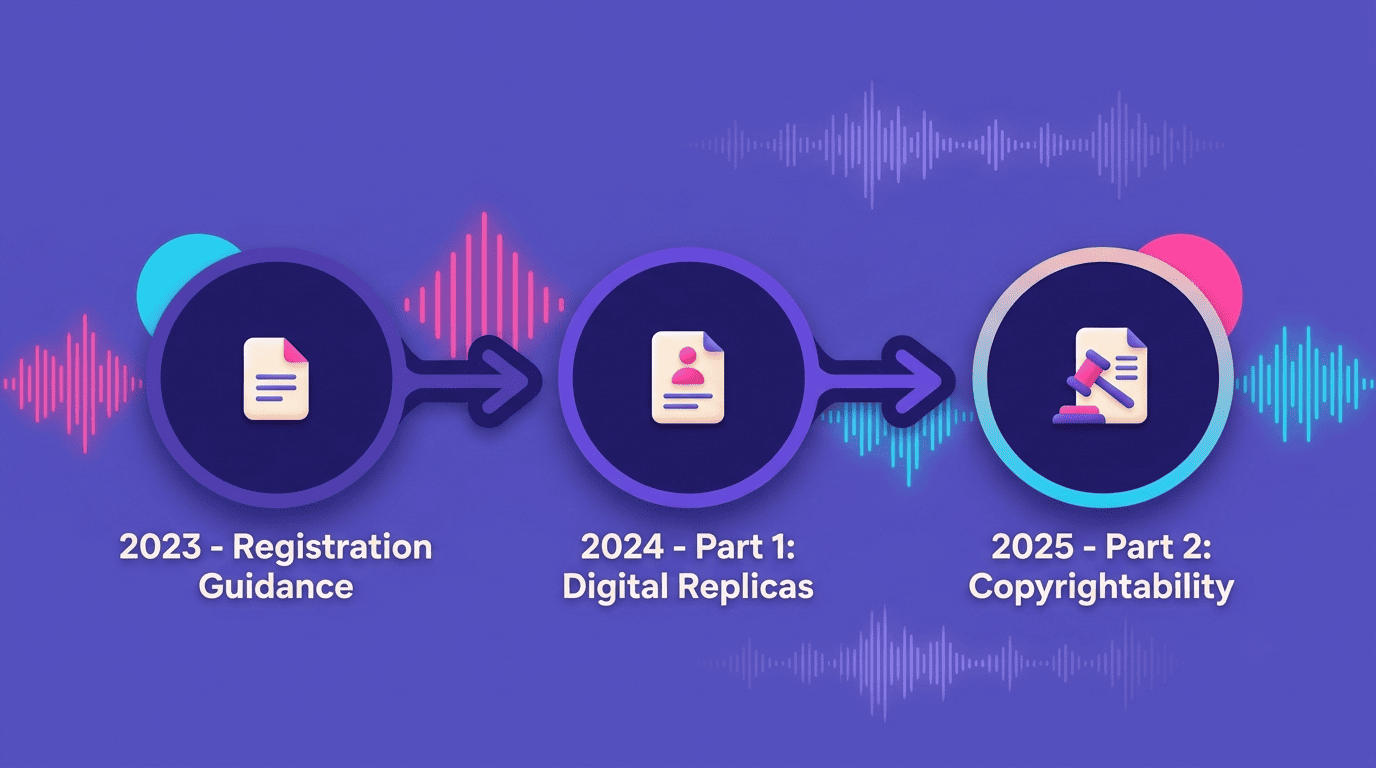
In March 2023, the Office issued registration guidance covering works that contain AI-generated material, requiring applicants to disclose AI involvement. It followed with “Copyright and Artificial Intelligence, Part 1: Digital Replicas” on July 31, 2024, and “Part 2: Copyrightability” on January 29, 2025, after reviewing more than 10,000 public comments. The full reports are published on copyright.gov/ai, the Office’s official AI initiative page.
The verbatim standard on prompts
The most-cited line from the Part 2 report addresses the exact scenario most AI-assisted song creators face: typing a text prompt and letting the model do the rest. The Office concluded that prompts alone are not enough for legal authorship — a standard summarized well by WIPO Magazine, the publication of the World Intellectual Property Organization. In practice, this is the single most important takeaway of this entire debate: prompting, by itself, is not a copyrightable act.
How Human Input Changes Who Owns It
Not every AI-assisted song is treated the same — the amount and kind of human creative input is what separates an unprotectable file from a legitimately copyrightable work.
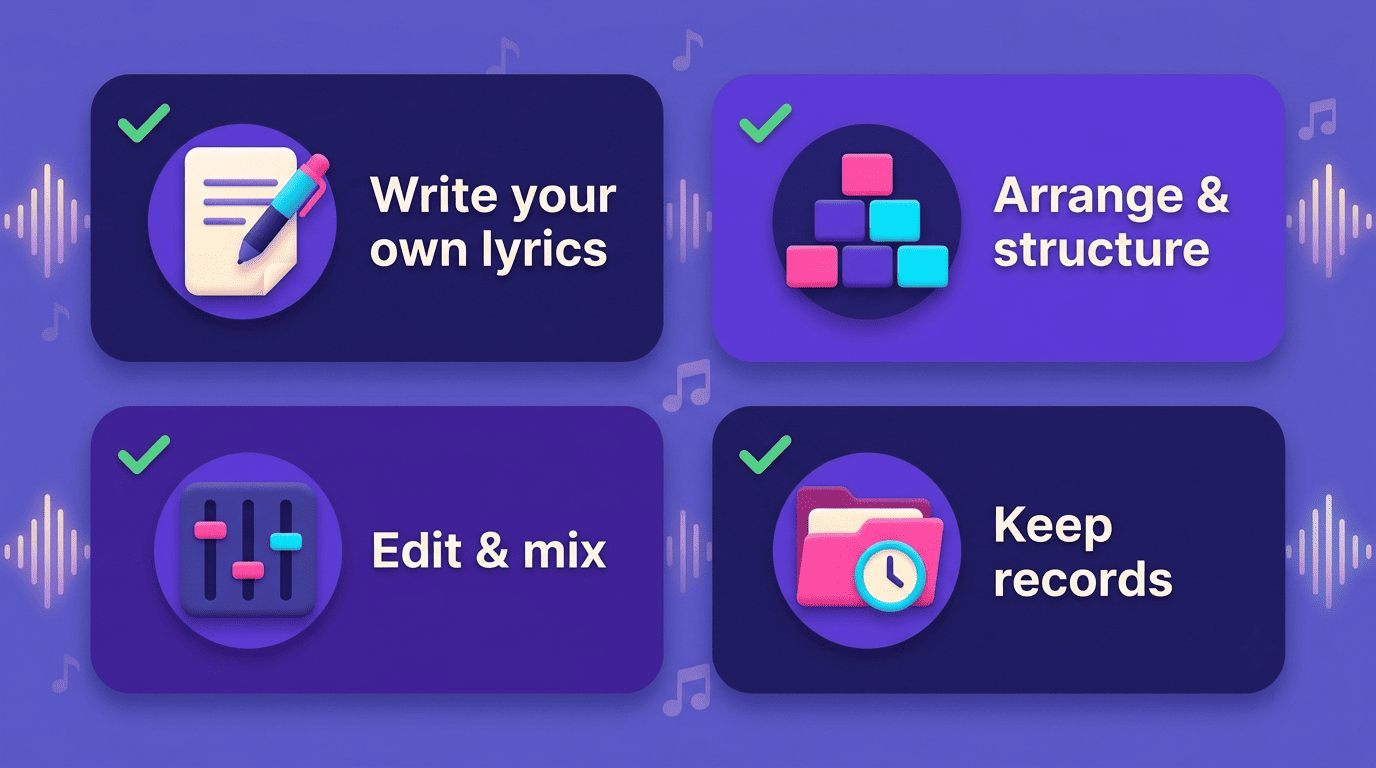
Write your own lyrics. Original lyrics are human-authored text, and they are protectable independently of the AI-generated melody or vocal performance layered underneath them.
Make and document deliberate arrangement choices. Structuring verses, choruses, and transitions, or selecting and sequencing AI-generated stems into a finished arrangement, is the kind of creative judgment the Copyright Office treats as human authorship.
Edit, mix, and modify the output. Meaningful post-production — remixing, re-recording sections, layering human vocals over AI instrumentals — can shift a track from “AI output” toward a human-authored derivative.
Keep records as you go. Save your prompts, project files, timestamped versions, and any receipts or session logs. If your registration or ownership is ever questioned, this is the evidence that shows what you personally contributed.
The line the Office draws, in its own words, is “whether AI is enhancing human expression or is the source of the expressive choices.” Original lyrics, deliberate arrangement, editing, mixing, and meaningful modification can earn copyright — but only on the human-authored portions, never on the underlying AI-generated audio itself. A notable real-world example is country singer Randy Travis, whose team built an AI model on his decades of historic vocal recordings to recreate his voice after a stroke left him unable to sing, then applied it over his touring band’s lead vocalist’s live vocal performance of the song. Because a human vocal performance was the actual source material being modified, the resulting sound recording was treated as legitimate assistive use rather than pure AI generation.
Platform Terms: Suno, Udio and Others
Even when copyright law says “no” to full protection, the platform you generate music on still sets separate, contractual rules about what you’re allowed to do with the file.
What the licenses grant (and don’t)
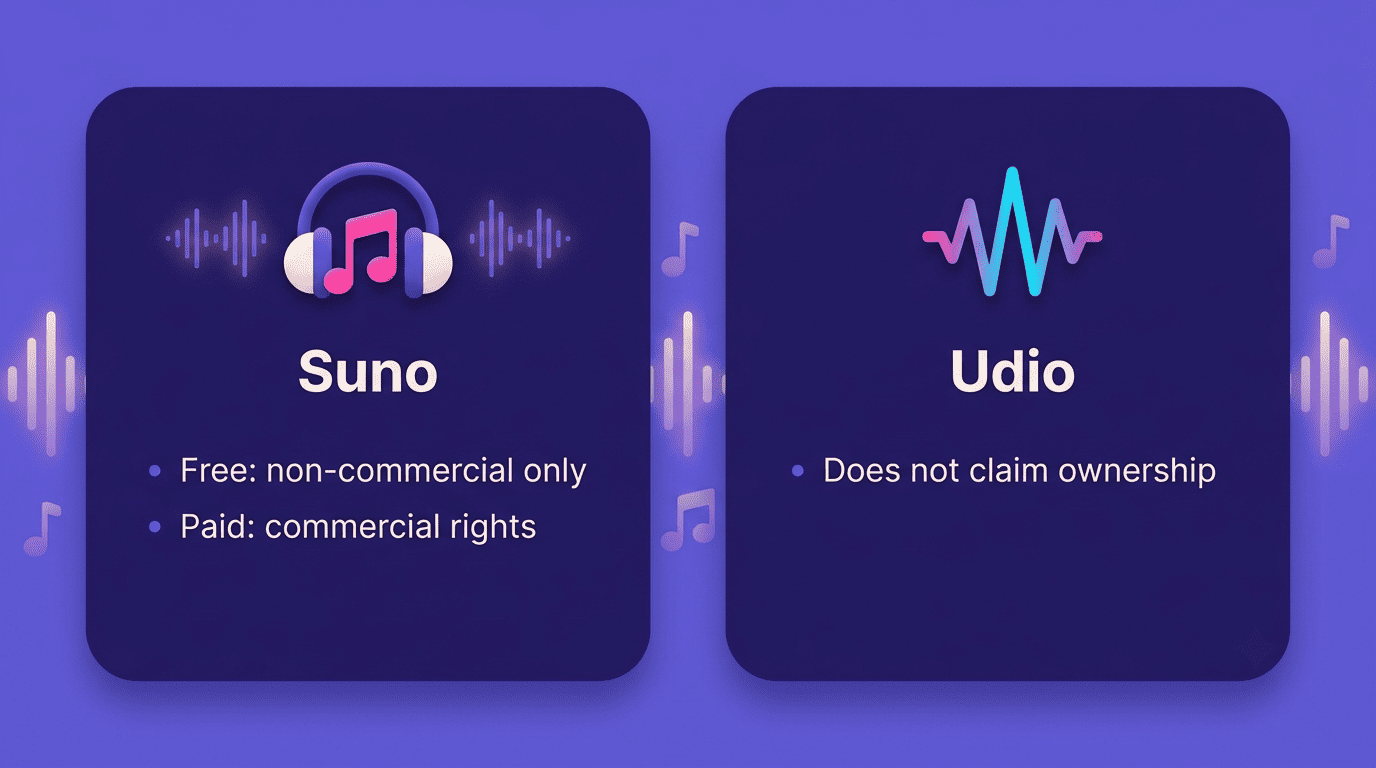
Suno’s free tier does not permit commercial use, and Suno itself retains ownership of that output, though non-commercial use is allowed with attribution. Paid subscribers get commercial rights to the sound recording under the current subscription terms, though the exact legal language Suno uses for this arrangement has shifted over time. Udio, by contrast, states it does not claim ownership of the content users generate on its platform. Terms change frequently across every AI music tool, so before releasing or selling a track, always verify:
- Commercial-use permission on your current plan
- Attribution requirements
- Resale or licensing limits
- Whether your rights survive if you cancel your subscription
| Platform | Free-tier commercial use | Ownership claim by platform |
|---|---|---|
| Suno | Not permitted | Suno retains ownership on free tier |
| Suno (paid) | Permitted per plan terms | User gets commercial rights per current terms |
| Udio | Varies by plan | Does not claim ownership of user output |
License ≠ copyright registration
A platform granting you “ownership” in its terms of service does not create a valid copyright registration with the government. It simply means the platform isn’t claiming the work for itself and is licensing use of it to you. Whether that same output actually qualifies for federal copyright protection is a separate legal question — one that depends on how much human creative input went into the track, and one you or an attorney need to assess independently of what any platform’s terms say.
A Quick Pre-Release Checklist
Before you publish or monetize a track made with a prompt-to-music workflow, run through these five checks:
- Confirm your current subscription plan actually permits the commercial use you intend (streaming, sync licensing, resale).
- Confirm any source material you uploaded — samples, reference vocals, stems — was legally cleared for this use.
- Document your own human creative contributions: lyrics, arrangement decisions, edits, and mix choices.
- Meet the AI-disclosure requirements of the distribution platform you’re releasing on (several streaming services now require this).
- Keep complete records — prompts, project files, dates, and licensing receipts — in case ownership or authorship is ever questioned.
Tools built around a text-to-music AI workflow can get you from idea to finished track in minutes, but the legal groundwork above is what actually protects that track once it’s public.